Registration Certificate vs. Certificate of Analysis: What Each Shows
By Julia Shulman, co-founder, Pure Fire Nutritional

Supplement companies increasingly publish documents alongside their products, and that is a good thing. But documents answer different questions, and it’s easy to read more into a certificate than it says. This explainer covers the two most common types, a state registration certificate and a certificate of analysis (COA), what each one shows, and what neither can tell you.
EAEU Certificate of State Registration
Pure Fire’s documentation library shows Eurasian Economic Union (EAEU) Certificates of State Registration, with English translations. A registration certificate records that a product was registered with authorities in that region. It typically lists:
- the product name as registered;
- a registration number and date;
- the manufacturer and country of manufacture.
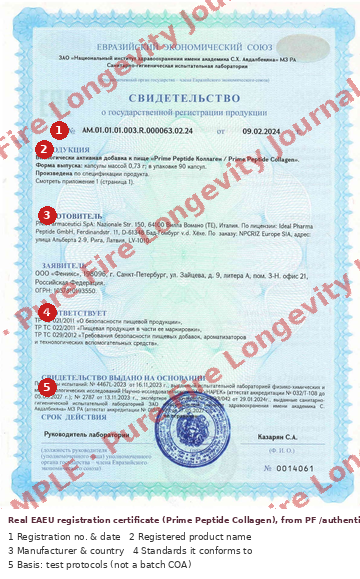
What it shows: that the product exists as a registered item in that jurisdiction, made by the named manufacturer. That helps you trace where a product came from and compare the name on your package with the registered name.
What it doesn’t show: it is not a test result for the specific batch you hold, and it is not evidence of any health effect. As Pure Fire’s own library puts it, a registration certificate is not a certificate of analysis.
Certificate of analysis (COA)
A COA reports laboratory tests on a specific production lot. It answers a narrower, more practical question: did this batch meet its specifications when it was tested? When reading one, check each of the following:
- Product and lot. The product name and lot (batch) number should match your package. A COA for a different lot tells you about that lot, not yours.
- Lab and date. Who tested it, and when? Note whether the lab is the manufacturer’s own or an independent one.
- Tests run. Common categories are identity (is it what it says?), purity or content, microbiology, and contaminants such as heavy metals.
- Specification and result. Each test should show the acceptance limit and the measured result, so you can see whether it passed and by how much.
- Methods. A named method lets you see how something was measured.
- Signature. A responsible person should sign or approve the report.
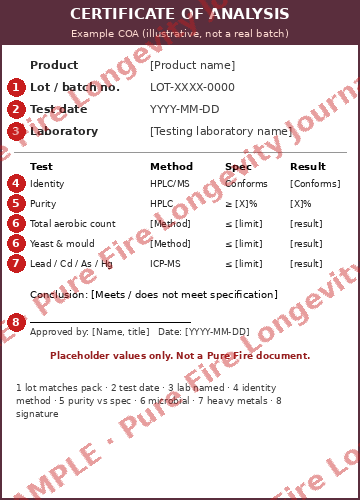
Watch for COAs with no lot number, no lab name, results stated only as “pass” with no specification, or dates that don’t fit the product’s manufacture date. Those don’t prove a problem, but they make the document much less informative.
What neither document shows
Neither document shows that a product works. A registration certificate shows that a product is registered; a COA shows what a batch contained when tested. Neither is FDA approval. In the US, dietary supplements are not approved by the FDA before sale (FDA’s dietary supplements page), and no peptide bioregulator is FDA-approved. Questions about whether a product does anything belong to the research literature, which we discuss in Research history vs. FDA approval and Organ pairings: mechanism vs. evidence.
Questions to ask a seller
- Is there a COA for the lot I received, and who performed the testing?
- Does the registered product name match the label?
- Where was the product manufactured, and by whom?
Related: Glossary · Oral vs. injectable delivery.