Where to Buy Authentic Khavinson Peptides in the USA: A Complete Guide
By Julia Shulman, co-founder, Pure Fire Nutritional

If you've been reading about Khavinson peptide bioregulators and trying to find a reliable source in the United States, you've probably hit the same wall many of our customers did. These products are hard to find here, and the sellers who do carry them are often hard to verify. In this post we explain why, what the risks are when you buy from a source you can't check, and how we approach sourcing at Pure Fire.
These statements have not been evaluated by the Food and Drug Administration. These products are not intended to diagnose, treat, cure, or prevent any disease.
Contents
- Why these products are hard to find in the US
- Oral bioregulators vs. injectable "peptides"
- The authenticity problem
- How to check any seller, including us
- How Pure Fire sources Khavinson bioregulators
- Getting started
- Sources
1. Why these products are hard to find in the US
Khavinson peptide bioregulators were developed in Russia and have been sold there, and in parts of Europe, for decades. Only a small number of specialized producers make them. The best known are connected to the St. Petersburg Institute of Bioregulation and Gerontology, where Professor Vladimir Khavinson did his foundational research. (New to the topic? Start with Khavinson Peptides Explained: Benefits, Research & How They Work)
These products have never gone through the FDA drug approval process, so they can't be marketed as drugs in the US. Oral bioregulators are sold here as dietary supplements. Under DSHEA, the 1994 law covering supplements, the FDA doesn't review supplements for effectiveness before they go on sale. The company selling them is responsible for safety and for making sure the label is truthful (FDA; NIH Office of Dietary Supplements). Because they're made abroad, you won't find them in US pharmacies, supplement stores, or most online shops.
That leaves most Americans dealing with international shipping, currency exchange, language barriers, and real uncertainty about what's actually in the package. That uncertainty is what Section 3 is about.
2. Oral bioregulators vs. injectable "peptides"
A lot of what's sold online as "peptides" are injectables, often labeled "For Research Use Only." Johns Hopkins notes that many unapproved peptides are sold illegally online, and that a "research use only" label doesn't get a seller around the legal requirements (Johns Hopkins Bloomberg School of Public Health, 2026).
We only sell oral bioregulators, as dietary supplements. Much of the older Khavinson research used injected preparations, and results from injections can't be assumed to apply to capsules. We go into this more in our perimenopause article.
3. The authenticity problem
When demand is high and supply is small, a secondary market grows. Search online for Khavinson peptides and you'll find all kinds of sellers. Some resell gray-market products of unclear origin. Others sell products that use the Khavinson name but aren't made by the original producers.
That matters. A product with the same name, made by a different manufacturer or without the same quality controls, isn't the same product. The peptide sequence, purity, and amount per capsule could all be different.
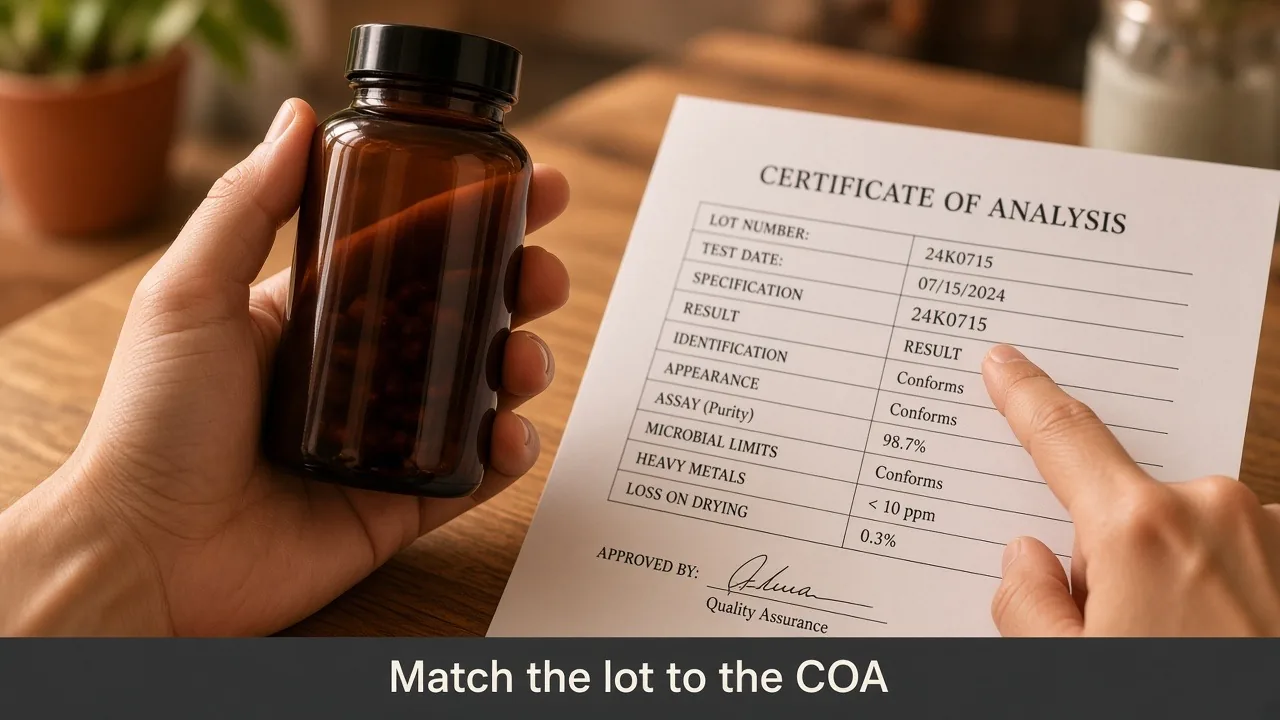
Then there's the most basic question: what's actually in the bottle? Without a documented supply chain and a direct relationship with the manufacturer, you have no reliable way to know. The next section gives you a way to check.
4. How to check any seller, including us
Please use this checklist with every seller, us included:
- A Certificate of Analysis (COA) whose lot number matches the bottle.
- A clear Supplement Facts panel, plus the manufacturer's or distributor's name and contact information (NIH ODS).
- Single-ingredient products over blends. Harvard Health makes this point about supplements generally: with a single ingredient, you know what you're getting (Harvard Health).
- No disease or treatment claims. A supplement legally can't promise to cure or treat anything. If a seller does, that's a red flag (NIH ODS).
- A way to report problems. If you have a bad reaction, stop the product, tell your clinician, and report it to the FDA through MedWatch and to the seller.
You can see how we document our own products on our Authenticity page.
Same product name, lower price elsewhere? See Same Name. Same Peptides. So Why Buy From Us?
5. How Pure Fire sources Khavinson bioregulators
We started Pure Fire to close this gap. We source directly from the original manufacturers in the Khavinson research lineage, and we are an authorized US retailer of their products.
So when you order from us, you get the manufacturer's own product, not a generic version or a gray-market import of unknown origin, shipped to you within the US. Every lot comes with its documentation (see Section 4).
We carry Cytomaxes, Cytogens, the Revilab ML and SL series, and other formulations from the Khavinson lineage. We store and handle them carefully from the manufacturer to your door. Like any supplement, they support normal body function and aren't meant to treat any condition.
These statements have not been evaluated by the Food and Drug Administration. These products are not intended to diagnose, treat, cure, or prevent any disease.

6. Getting started
- New to bioregulators? Read Khavinson Peptides Explained: Benefits, Research & How They Work. For the bigger picture, read Peptides in Context: A Systems View.
- The research background: Visit our Science page.
- Ask Pepita: Our AI assistant, Pepita, can help you find your way around the catalog and documentation. Pepita isn't a clinician and doesn't give medical advice or dosing guidance.
- Browse: See all products or just the peptide bioregulators.
- Shipping: Shipping is $19.95, and free on orders of $150 or more.
- Practical details: Read our shipping, returns, and FAQ pages.
- Talk with your clinician before starting any supplement, especially if you're pregnant, nursing, or taking medications.
- More posts: Visit the Longevity Journal.
Sources
- U.S. FDA. Dietary Supplements Guidance Documents & Regulatory Information (DSHEA). Link
- NIH Office of Dietary Supplements. Dietary Supplements: What You Need to Know. Link
- Johns Hopkins Bloomberg School of Public Health. More Peptides Could Hit the Market Soon (Aug 2026). Link
- Harvard Health Publishing. Menopause supplements: Effective relief or empty promises? (2024), with general advice on blends and USP/NSF seals. Link
- U.S. FDA. MedWatch: Safety Information and Adverse Event Reporting Program. Link
This article is for educational purposes only and isn't medical advice. These statements have not been evaluated by the Food and Drug Administration. These products are not intended to diagnose, treat, cure, or prevent any disease.