Khavinson Peptides Explained: Benefits, Research & How They Work
A different approach to peptide science.
By Julia Shulman, co-founder, Pure Fire Nutritional

Peptides are tiny chains of amino acids, the same building blocks that make up proteins. Some peptides help cells communicate and help regulate normal processes in the body.
Khavinson peptide bioregulators are a group of short peptides and peptide complexes. Researchers study them for how they may influence cell activity and tissue function. They've looked at possible roles in healthy aging and normal body regulation. It's still a developing area, and the evidence varies from one peptide to the next. We'll be honest with you about where it stands.
These statements have not been evaluated by the Food and Drug Administration. These products are not intended to diagnose, treat, cure, or prevent any disease.
Contents
- Where they come from
- Two types you'll find at Pure Fire
- Oral capsules vs. injected research forms
- What the research does and doesn't show
- Supplements, not medicines
- Explore what interests you
- How we can help
- Sources · Recommended reading
1. Where they come from
Bioregulators came out of decades of work led by Professor Vladimir Khavinson at the St. Petersburg Institute of Bioregulation and Gerontology in Russia. His group proposed that certain very short peptides relate to specific tissues and may help those tissues with their normal signaling. That's a hypothesis, and it's still being studied. Much of the research comes from his own group, and large independent human trials are still missing (see Section 4). His group's 2021 review summarizes their gene-regulation idea (Khavinson et al. 2021, PubMed 34834147).
If you'd like the bigger picture of why we think about peptides as signals inside connected systems, read Peptides in Context: A Systems View.
2. Two types you'll find at Pure Fire
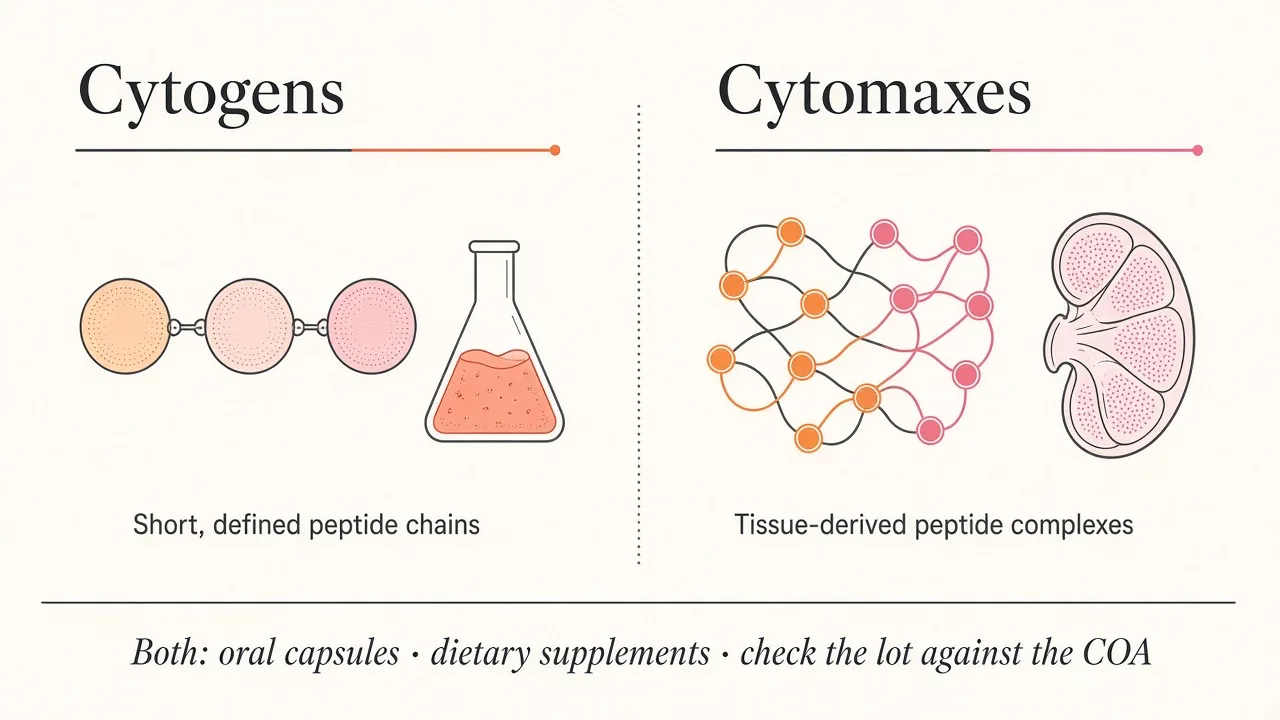
- Cytogens: defined short peptides. These are made in a lab using specific amino-acid sequences.
- Cytomaxes: natural peptide complexes. These are mixtures of peptides extracted from animal tissues.
Both come from the Khavinson research tradition, but they're made differently and have different compositions. If you like knowing exactly which sequence you're taking, Cytogens are the more defined option. Whichever you choose, check that the lot on your bottle matches its Certificate of Analysis (see how we document authenticity).
3. Oral capsules vs. injected research forms
This is the point we most want you to take away. The bioregulators we sell are oral capsules, sold as dietary supplements. A lot of the older Khavinson research, including the best-known human studies, used injected preparations like Thymalin and Epithalamin. Results from injections can't be assumed to apply to capsules. The body handles the two routes very differently.
There is some animal evidence that short peptides can act when given by mouth. A 2025 review of Epitalon notes that most studies used injection, describes one rat study using oral dosing, and treats oral delivery as an open research question (Araj et al. 2025, PubMed 40141333). How well people absorb intact short peptides from capsules hasn't been well studied.
The injectable "peptides" sold online are a different world. Johns Hopkins notes that many unapproved peptides are sold illegally online, often labeled "research use only" (Johns Hopkins Bloomberg School of Public Health, 2026). We don't sell injectables.
4. What the research does and doesn't show
Here are the kinds of studies behind bioregulators, described plainly:
- Animal studies of a pineal extract. In 1998, Khavinson's colleagues studied Epithalamin, a pineal-gland extract, in fruit flies, mice, and rats. They reported changes in melatonin and in markers of oxidative stress, along with other age-related outcomes in those animals. These were animals given an extract, not people taking capsules (Anisimov et al. 1998, PubMed 9701766).
- A small, older human study of injected forms. In 2003, Khavinson and Morozov reported on 266 older adults followed for 6 to 8 years. Participants received injected Thymalin and/or Epithalamin during the first 2 to 3 years, and the authors reported changes in a range of body markers. It's a single study, decades old, run by the developers' own institute, using injected forms in people over 60 (Khavinson & Morozov 2003, PubMed 14523363).
- Primate work on endocrine markers. A 2005 study of older rhesus monkeys reported changes in glucose, insulin, and nighttime melatonin patterns with Epitalon, a synthetic pineal peptide. Young animals showed no such changes (Goncharova et al. 2005, PubMed 15664732).
- Reviews. The Epitalon review above (PubMed 40141333) and the developers' own review (PubMed 34834147) summarize lab, animal, and human work and are open about the gaps.
What's missing: large, independent, controlled human trials of oral bioregulators. Until those exist, we treat bioregulators as part of a research tradition worth taking seriously, not as proven solutions. If you're reading about bioregulators for a particular life stage, our perimenopause article walks through the same evidence in more detail.
5. Supplements, not medicines
Bioregulators sold in the US are dietary supplements. Under DSHEA, the FDA doesn't review supplements for effectiveness before they're sold. The company is responsible for safety and for an honest label. A supplement may say it supports a normal body function, but it can't claim to treat a disease (FDA; NIH Office of Dietary Supplements).
A few habits that keep you safe:
- Talk with your clinician first, especially if you're pregnant, nursing, or taking medications (NIH ODS).
- Try one new product at a time.
- Follow the label and your clinician's guidance. We don't give dosing advice in our articles.
- If you have a bad reaction, stop the product, tell your clinician, and report it to the FDA through MedWatch.
These statements have not been evaluated by the Food and Drug Administration. These products are not intended to diagnose, treat, cure, or prevent any disease.
6. Explore what interests you
Curious about the research connected to a particular part of the body? Browse our peptide bioregulators by body system to see the ingredients, formulations, and the evidence we have (and don't have) for each. Keep the injected-vs-oral point from Section 3 in mind as you read.
7. How we can help
- Ask Pepita: Our AI assistant, Pepita, can walk you through the catalog and documentation. Pepita isn't a clinician and doesn't give medical or dosing advice.
- Wondering where to buy in the US? Read Where to Buy Authentic Khavinson Peptides in the USA: A Complete Guide.
- Shipping: Shipping is $19.95, and free on orders of $150 or more (shipping details).
- More answers: See our FAQ and our Science page.
- Want the deeper science? The Short Peptide has detailed explanations of the research.
— Julia
Sources
- Anisimov VN, Mylnikov SV, Khavinson VK. Pineal peptide preparation epithalamin… in fruit flies, mice and rats. Mech Ageing Dev. 1998;103(2):123–132. Animal study. PubMed 9701766
- Khavinson VKh, Morozov VG. Neuro Endocrinol Lett. 2003;24(3–4):233–240. Small, older human study of injected Thymalin and Epithalamin in older adults. PubMed 14523363
- Goncharova ND, et al. Pineal peptides restore the age-related disturbances in hormonal functions of the pineal gland and the pancreas. Exp Gerontol. 2005;40(1–2):51–57. Rhesus monkeys. PubMed 15664732
- Araj SK, et al. Overview of Epitalon, a highly bioactive pineal tetrapeptide. Int J Mol Sci. 2025;26(6):2691. Review. PubMed 40141333
- Khavinson VK, et al. Peptide regulation of gene expression: a systematic review. Molecules. 2021;26(22):7053. Developers' group. PubMed 34834147
- U.S. FDA. Dietary Supplements Guidance Documents & Regulatory Information. Link
- NIH Office of Dietary Supplements. Dietary Supplements: What You Need to Know. Link
- Johns Hopkins Bloomberg School of Public Health. More Peptides Could Hit the Market Soon (Aug 2026). Link
- U.S. FDA. MedWatch. Link
Recommended reading
- Peptides in Context: A Systems View
- Where to Buy Authentic Khavinson Peptides in the USA: A Complete Guide
- Oral Khavinson Bioregulators in Perimenopause: What the Research Does (and Doesn't) Show
- How we document authenticity · Longevity Journal
This article is for educational purposes only and isn't medical advice. These statements have not been evaluated by the Food and Drug Administration. These products are not intended to diagnose, treat, cure, or prevent any disease.