Oral vs. Injectable Peptide Bioregulators: Digestion and Delivery
By Julia Shulman, co-founder, Pure Fire Nutritional
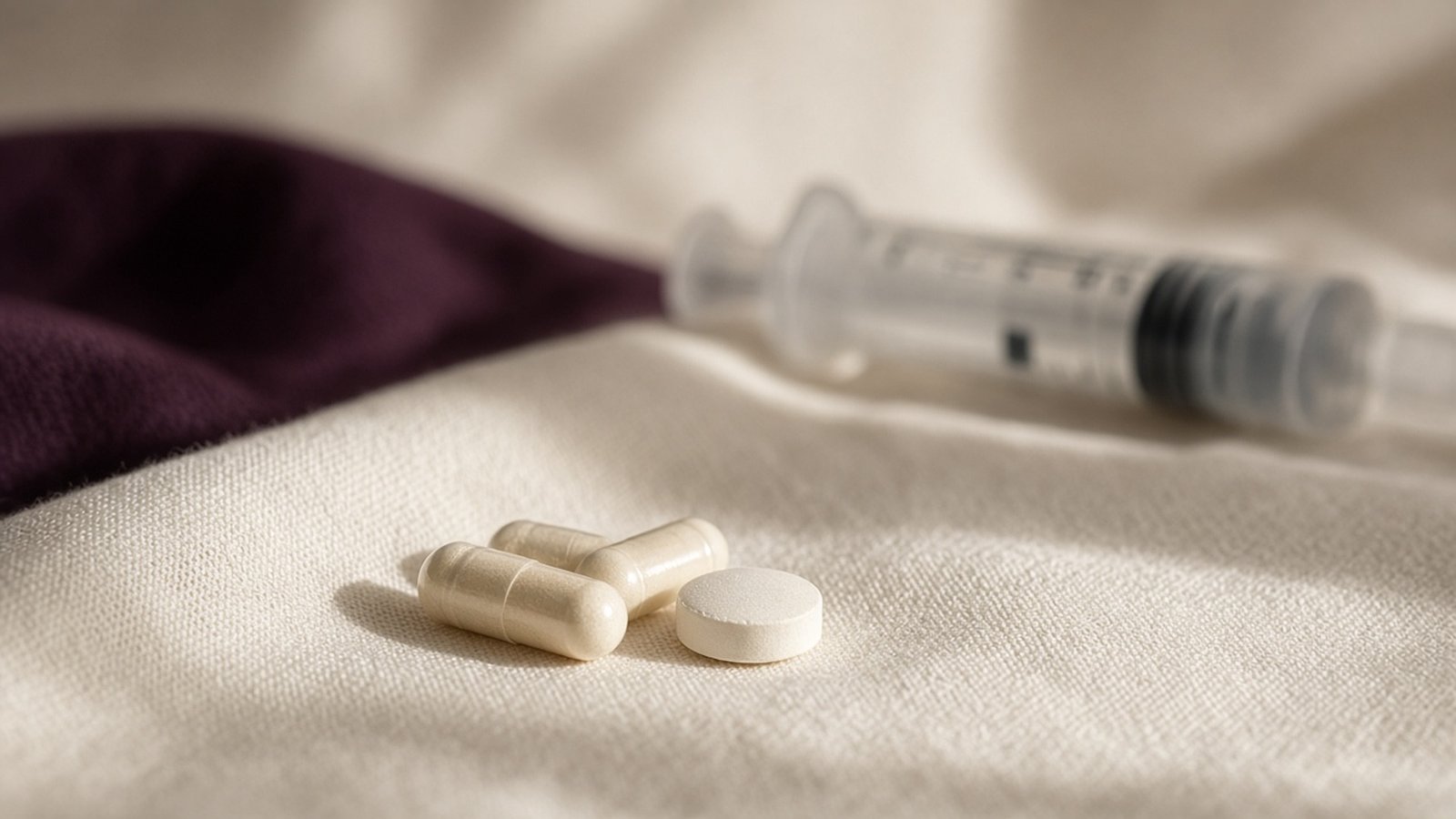
How a peptide enters the body is the first question, before any proposed target.
Not every peptide is a bioregulator. “Peptide” names a molecular structure, a short chain of amino acids joined by peptide bonds. “Bioregulator” points to a proposed biological role: in the research tradition associated with Vladimir Khavinson, certain short peptides and peptide complexes are proposed to take part in regulating cellular activity in particular tissues. A short chain alone doesn’t establish what a compound does in the body, and taking a peptide by mouth raises a separate question: what survives digestion and becomes available to tissues at all?
Khavinson bioregulators exist in two broad delivery forms. Injectable preparations used in Russia include Thymalin, Epithalamin, Cortexin and Retinalamin, which are injectable drugs. Oral forms are sold as capsules or sublingual products. In the United States, the oral products are sold as dietary supplements. They are not FDA-approved drugs, and this article does not describe them as treatments for any condition. This guide explains what happens to a peptide you swallow, how oral and injectable delivery differ, and how to read the human research without mistaking a biological model for an established benefit.
Key takeaways
- The digestive tract is built to break proteins and peptides down; that is established physiology.
- Very short peptides (two or three amino acids) can be carried across the gut lining by a transporter called PEPT1; that is also established.
- Whether a specific oral bioregulator reaches a specific organ intact is a hypothesis that has not been confirmed in rigorous human studies.
- Human studies of bioregulators used both oral and injected forms. Results from the two routes should not be pooled.
- Delivery format, product quality and evidence are three separate questions. None of them settles the others.
Contents
- Peptide vs. bioregulator: structure and proposed role
- Where oral bioregulators come from
- What happens to a peptide you swallow
- Short peptides and the PEPT1 transporter
- Oral forms: Cytomaxes and Cytogens
- Injectable preparations
- Quality and safety considerations
- What the human evidence does and doesn’t show
- Pure Fire Nutritional’s oral range
- Frequently asked questions
Peptide vs. bioregulator: structure and proposed role
Peptides are chains of amino acids. Some peptides in the body bind receptors on or inside cells; others act as hormones or take part in signaling pathways. That is general biology, and it is why peptides attract research interest. It does not mean that any particular supplement has one of those roles.
A peptide bioregulator, in Khavinson’s usage, is a short amino-acid chain or peptide complex proposed to influence cellular activity associated with a particular tissue. The emphasis is on regulation and signaling rather than supplying building material the way dietary protein does. The synthetic peptides in this tradition are very short, typically two to four amino acids. Thymogen, for example, is the dipeptide L-Glu-L-Trp (PubMed 9637345). Size describes structure, not potency: a shorter chain doesn’t by itself show how a compound behaves, whether it survives digestion, or what it does in the body.
Product descriptions often name an organ. On Pure Fire’s product pages, Cerluten is complex A-5 (brain), Thyreogen A-2 (thyroid), Chelohart A-14 (heart) and Gotratix A-18 (muscle). Those labels indicate the source tissue or intended focus. They are proposed associations, not proof that a product acts only, or at all, in that organ. Our companion article, Bioregulator organ pairings: proposed mechanism vs. measured evidence, covers this in detail.
Where oral bioregulators come from
Khavinson’s research program began in the Soviet Union in the 1970s and developed in two generations: organ-derived peptide extracts first, then synthetic short peptides designed around them. That history explains why some products are described as organ complexes and others by an amino-acid sequence. It is a research lineage, not evidence of effect for a given product. For the broader regulatory and historical picture, see Khavinson peptide bioregulators: research history vs. FDA approval.
Ageing research is part of that history, and a lot of popular writing about bioregulators centres on longevity. A proposed influence on cellular activity does not establish an effect on ageing, lifespan, inflammation or hormone function in people. Each of those outcomes would need evidence specific to the molecule, the route and the result being measured.
What happens to a peptide you swallow
A capsule or tablet passes through the digestive tract; an injection bypasses it. That difference is the core of this article. In the stomach, acid and the enzyme pepsin begin breaking proteins down. In the small intestine, pancreatic enzymes and peptidases on the intestinal lining cut peptides into smaller fragments and free amino acids. This is how the body gets nutrition from dietary protein, and it does not distinguish between a protein in food and a peptide in a capsule.
For that reason most peptide medicines are injected, and oral peptide drugs that do exist rely on specialised formulation technology, such as enzyme inhibitors or permeation enhancers, to get enough intact peptide into the bloodstream (Drucker, 2020, Nature Reviews Drug Discovery). A standard capsule without that kind of technology should be expected to face the full digestive process. The amount of peptide on a label therefore does not tell you how much remains intact, crosses the intestinal lining or reaches a particular tissue.
Short peptides and the PEPT1 transporter
Established biology: the small intestine absorbs many di- and tripeptides from ordinary food through the proton-coupled transporter PEPT1 (SLC15A1), as described in a 2013 review in The Journal of Physiology. Because cytogens are so short, this transporter is often discussed as a plausible route for them.
Hypothesis: Khavinson’s group proposes that short peptides can act on cells and influence gene expression (Khavinson et al., 2012). Being a possible PEPT1 substrate does not show that a peptide reaches a target tissue intact or in meaningful amounts, and this has not been demonstrated for oral bioregulator products in independent human studies. Even absorption into the blood would be only one step; it would not, by itself, show delivery to the pineal gland, thymus or any other proposed target.
Oral forms: Cytomaxes and Cytogens
Pure Fire’s oral range includes two groups. Cytomaxes are organ-derived peptide complexes; Cytogens are synthetic short peptides. Organ-derived complexes contain longer and more varied peptides than cytogens, so the digestion question is even more open for them. The manufacturer’s press kit also notes that sublingual Cytomaxes and Cytogens exist, mostly as single-peptide products. These labels distinguish product groups; they don’t, by themselves, describe a biological outcome. See the glossary for how these names and A-numbers are used.
Injectable preparations
Thymalin, Epithalamin, Cortexin and Retinalamin are injectable drugs registered in Russia. Injection avoids the digestive barrier, but the route alone doesn’t establish a preparation’s safety, effectiveness or suitability. Findings from injected preparations cannot be assumed to apply to oral capsules containing related material, and an injectable schedule should never be translated into an oral one: the routes differ too much.
Quality and safety considerations
Quality concerns both the compound and the finished product. Identity, purity and possible contamination all matter, because a label alone cannot establish what a capsule contains. Our explainer on registration certificates vs. certificates of analysis covers what product documents do and don’t show, and Pure Fire’s documentation library publishes the registration certificates it holds. Manufacturing and documentation language describe how a product is made and registered; they don’t establish that it works.
Safety depends on the molecule, the route, product purity, possible interactions and a person’s own health circumstances. A short peptide isn’t automatically safe because of its size. Anyone taking prescription medicines, pregnant or breastfeeding, or managing a health condition should talk to a healthcare professional before using any supplement.
What the human evidence does and doesn’t show
Human studies exist for both routes. Oral studies include Cytomax-type (cytamin) and Cytogen capsule work, for example PubMed 22448364. Studies are generally small, mostly come from the originating research group, and often lack a comparison group. Because absorption differs so much between routes, oral and injected results should be read separately: a result from an injected preparation tells you little about a capsule.
When reading any study, ask three questions: what form was given and by which route, what was actually measured (a cell marker, a blood test, a symptom score), and whether there was a comparison group. A laboratory signal, a tissue response and a meaningful human outcome are different kinds of evidence. The Short Peptide, an independent reference site, summarises this research in plain language for readers who want to go further.
Pure Fire Nutritional’s oral range
Pure Fire Nutritional carries oral Khavinson Cytomaxes and Cytogens, along with Prime Peptide products. They are sold as dietary supplements, not as treatments. Before considering one, it helps to be clear about the question you’re asking: are you exploring terminology, a proposed tissue association, or how oral delivery differs from injection? The Longevity Journal has more background on each.
Frequently asked questions
Are oral bioregulators the same as the injectable drugs?
No. They are different products, delivered by different routes, with different regulatory status.
Do oral peptides survive digestion?
Most dietary peptides are broken down; some di- and tripeptides are absorbed intact via PEPT1. Whether a particular bioregulator reaches a particular organ is unproven.
How are bioregulators different from vitamins?
A vitamin supplies a named nutrient with an established role. Bioregulators are proposed signaling molecules; their role is a hypothesis. In the US, both are sold under dietary supplement rules (FDA’s dietary supplements page), which is not FDA approval.
How small are they?
Cytogens are typically two to four amino acids long. Cytomaxes are organ-derived complexes with more varied peptides.
How can I check what a product is?
See Registration certificates vs. certificates of analysis and Pure Fire’s documentation library.