Oral Khavinson Bioregulators in Perimenopause: What the Research Does (and Doesn't) Show
By Julia Shulman, co-founder, Pure Fire Nutritional

Some women take oral Khavinson bioregulators as dietary supplements during perimenopause, the years when the body is adjusting to hormonal changes. We sell oral bioregulators at Pure Fire, so we want to be clear with you from the start. These products are not FDA-approved to treat menopause or any of its symptoms. The research on them is limited. Most of it used injected forms, not capsules. Please talk with your clinician before you add anything new.
These statements have not been evaluated by the Food and Drug Administration. These products are not intended to diagnose, treat, cure, or prevent any disease.
The short version
- The best-known human data comes from small, older studies of injected peptide preparations in older adults. None of it comes from perimenopause trials. (Evidence)
- Epitalon has shown activity when given orally to animals. Whether people absorb oral peptides the same way is still an open question. (How oral forms work)
- The FDA does not review dietary supplements for effectiveness before they're sold. (Supplement status)
- Check with your clinician, and make sure the lot number on your bottle matches its Certificate of Analysis (COA). (Verifying quality)
From Pure Fire: We carry single-sequence oral Khavinson bioregulators, and every lot comes with its documentation. You can browse our bioregulators or see how we document authenticity. If you're new to all this, start with What Are Khavinson Peptide Bioregulators?
Contents
- What Khavinson bioregulators are, and why we only talk about oral forms
- What the evidence says about midlife endocrine health
- What "dietary supplement" actually means
- How oral bioregulators are made and what to expect
- How to verify quality
- Questions to bring to your clinician
- Why we focus on Khavinson bioregulators
- How we can help you choose
- Medical disclaimer
- FAQ
- Sources
- Recommended reading
1. What Khavinson bioregulators are, and why we only talk about oral forms
Khavinson bioregulators are short peptides, just a few amino acids long. They came out of decades of work led by Professor Vladimir Khavinson at the St. Petersburg Institute of Bioregulation and Gerontology in Russia. The idea behind them is that specific short peptides relate to specific tissues, such as the pineal gland or thymus. That idea is still being studied. It isn't settled science. We go into the background more in What Are Khavinson Peptide Bioregulators? and on our Science page.
Here's what this article covers, and what it doesn't:
- Oral only. We talk about capsules taken by mouth, sold as dietary supplements.
- Supplement framing. We describe how they're positioned to support normal body function, not to treat any condition.
- Research context. When we cite a study, we tell you what form was used and who was studied.
- Routes don't transfer. Results from injected preparations don't tell you what a capsule will do. We'll keep pointing this out, because it matters (more in Section 4).
2. What the evidence says about midlife endocrine health
We want to be honest about how thin this evidence is. Here's what exists:
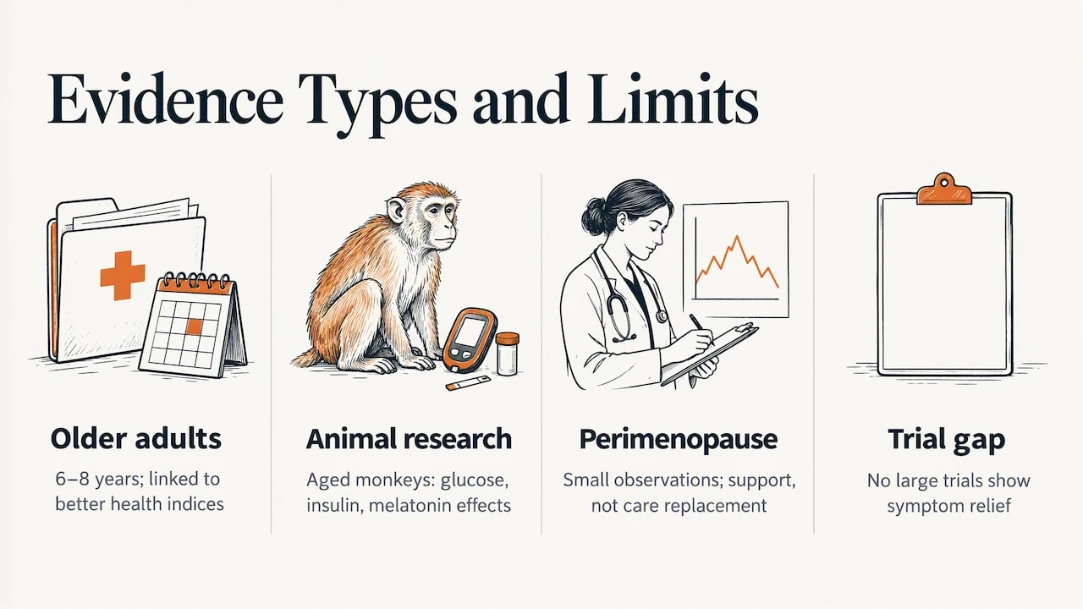
A small, older human study of injected preparations in older adults. In 2003, Khavinson and Morozov reported on 266 older adults followed over 6 to 8 years. Participants received injected Thymalin (a thymus extract) and/or Epithalamin (a pineal extract) during the first 2 to 3 years. The authors reported changes in several cardiovascular, endocrine, immune, and metabolic markers. This was a single study, decades old, run by the institute that developed these preparations, using injected forms in people over 60. It doesn't tell us anything direct about oral capsules or about perimenopause. (PubMed 14523363)
Animal work on the pineal peptide. A 2005 study in older rhesus monkeys looked at Epitalon, a synthetic four-amino-acid peptide (Ala-Glu-Asp-Gly) based on Epithalamin. In the older animals, researchers reported changes in glucose and insulin patterns and in nighttime melatonin levels. Young animals showed no such changes. These were monkeys, the study was small, and the paper doesn't establish that the effects carry over to people. (PubMed 15664732)
A 2025 review of Epitalon. Researchers at the Medical University of Warsaw reviewed about 25 years of lab, animal, and computer-modeling studies. They note that most in-vivo work used subcutaneous injection. They also describe a rat study where Epitalon given by mouth had measurable effects, and say that oral delivery is still an area for future work. It's a helpful map of what's known, and it's open about how little structural and human data there is. (PubMed 40141333)
Perimenopause-specific human data. We looked for clinical studies of oral Khavinson bioregulators in perimenopausal women and couldn't find any we could verify. So we're not citing any.
The limits. Midlife symptoms are very responsive to expectation. Harvard Health reports that placebos alone can reduce hot flashes by about 30%, measured objectively. The Menopause Society's 2023 position statement on nonhormone therapy doesn't recommend any dietary supplement for vasomotor symptoms. (Harvard Health; Menopause Society 2023, PubMed 37252752) So how good you feel isn't proof that a product worked. That's one more reason to make decisions with a clinician (see Section 6).
3. What "dietary supplement" actually means
Under the Dietary Supplement Health and Education Act of 1994 (DSHEA), supplements are regulated differently from drugs. A few things to know:
- No pre-market approval. The FDA doesn't evaluate whether a supplement works before it goes on sale. The manufacturer is responsible for making sure the product is safe and the label is truthful. (NIH ODS; FDA DSHEA guidance)
- Structure/function claims only. A supplement can say it supports a normal body function. It can't say it treats a disease, and that kind of claim has to carry the FDA disclaimer you'll see throughout this article.
- Peptides are a gray zone right now. Johns Hopkins notes that many peptides sold online, especially injectables, have not been reviewed for safety or effectiveness. (Johns Hopkins Bloomberg School of Public Health, 2026)
A quick label checklist:
- A Supplement Facts panel listing each ingredient and amount
- The manufacturer's or distributor's name and contact information
- A lot number and expiration date
- The DSHEA disclaimer next to any structure/function statement
If you're pregnant or nursing, NIH advises caution with any supplement beyond a standard prenatal, because most haven't been well tested in those groups. (NIH ODS)
4. How oral bioregulators are made and what to expect
Oral bioregulators usually come as capsules containing a synthesized short peptide or a tissue-derived peptide complex, plus fillers. Here's what we can and can't say:
- Animal oral data exists. As noted in Section 2, at least one rat study showed effects from oral Epitalon.
- Human oral data is thin. We don't have good evidence on how much of an oral short peptide the human body absorbs intact.
- Routes aren't interchangeable. Injected and oral forms behave differently in the body. Please don't read injection studies as proof that a capsule will do the same thing.
- Please don't self-dose. We're not giving dosing guidance here. Follow the product label and your clinician's advice.
- No promised timelines. We're not going to tell you when you'll "feel something." Nobody can honestly promise that.
5. How to verify quality
Before you take any supplement, work through this in order:
- Match the lot. The lot number on your bottle should match the lot on the COA. If it doesn't, ask the seller before you use it. (Here's how we document ours.)
- Look for third-party testing. Harvard Health experts suggest looking for USP or NSF verification. NIH lists USP, NSF, and ConsumerLab.com as independent testers, and notes that a seal confirms quality, not safety or effectiveness.
- Read the Supplement Facts. Check that the ingredients and amounts match what the product claims.
- Choose single-sequence products over blends. With a one-ingredient product, you know what you're taking.
- Know how to reach the manufacturer, and how to report a problem. If you have a bad reaction, stop the product, tell your clinician, and report it to the FDA (800-FDA-1088 or the MedWatch online form) and to the manufacturer.
Tip: Take a photo of the label and the COA when your order arrives. If you ever have a question or a reaction, you'll have the lot number and documentation right there.
6. Questions to bring to your clinician
As a therapist, I've seen how much easier a hard conversation gets when you walk in with a list. Here's one you can use:
- Could this interact with my medications or other supplements?
- Should I see a menopause specialist?
- Are there baseline labs worth checking first?
- What should we watch for, and when should I stop?
A few habits that help:
- Try one new product at a time, so you can tell what's doing what.
- Report any adverse events to your clinician and to the FDA (see Section 5).
- Ask your clinician to add it to your medical record. NIH also offers a printable supplement and medicine record you can keep yourself.
7. Why we focus on Khavinson bioregulators
We're drawn to Khavinson bioregulators because they're short, defined sequences with a long research history behind them, and we think that history deserves careful, honest attention. That doesn't mean we'll promise they'll fix your hot flashes or your sleep. They won't be a cure for anything. At most, they're one small piece of a bigger plan that includes your clinician, sleep, movement, food, relationships, and the support you need through a real life transition.
Perimenopause can feel isolating. You deserve clear information, not hype.
— Julia
8. How we can help you choose
- Browse the store: All products or peptide bioregulators.
- Shipping: Shipping is $19.95 and free on orders of $150 or more. See shipping details.
- Buying guide: How to buy Khavinson peptides in the USA.
- Ask Pepita: Our AI assistant, Pepita, can answer product and documentation questions. Pepita isn't a clinician and can't give medical advice.
- Common questions: Visit our FAQ.
- Your clinician: Still the most important person to talk to.
For a deeper look at peptide research, our sister site The Short Peptide is a good place to read more.
Medical disclaimer
This article is for educational purposes only and isn't medical advice. Pure Fire Nutritional sells dietary supplements, not drugs. These statements have not been evaluated by the Food and Drug Administration. These products are not intended to diagnose, treat, cure, or prevent any disease. Talk with a qualified clinician before starting any supplement, especially if you're pregnant, nursing, taking medications, or managing a health condition.
FAQ
Are Khavinson bioregulators approved for menopause symptoms?
No. They're sold as dietary supplements, and the FDA hasn't approved them to treat any condition. See Section 3.
Does the injection research apply to oral capsules?
Not directly. Most human data used injected preparations in older adults. Oral absorption in people hasn't been well studied. See Section 4.
How do I know a product is what it says it is?
Match the bottle's lot number to its COA, look for third-party testing, and choose single-sequence products. See Section 5.
Can I take them alongside hormone therapy or other medications?
Ask your clinician. Interactions haven't been well studied. See Section 6.
Sources
- Khavinson VKh, Morozov VG. Neuro Endocrinol Lett. 2003;24(3-4):233-240. Small, older study of injected Thymalin and Epithalamin in 266 older adults over 6 to 8 years. PubMed 14523363
- Goncharova ND, Vengerin AA, Khavinson VKh, Lapin BA. Pineal peptides and age-related hormonal function in rhesus monkeys. Exp Gerontol. 2005;40(1-2):51-57. PubMed 15664732
- Araj SK, et al. Overview of Epitalon, a highly bioactive pineal tetrapeptide. Int J Mol Sci. 2025;26(6):2691. PubMed 40141333
- The North American Menopause Society. The 2023 nonhormone therapy position statement. Menopause. 2023;30(6):573-590. PubMed 37252752
- Harvard Health Publishing. Menopause supplements: Effective relief or empty promises? (2024). Link
- U.S. FDA. Dietary Supplements Guidance Documents & Regulatory Information. Link
- NIH Office of Dietary Supplements. Dietary Supplements: What You Need to Know. Link
- Johns Hopkins Bloomberg School of Public Health. More Peptides Could Hit the Market Soon (2026). Link